
With age, the skin changes not only on the outside. Fibroblast activity gradually declines, and the synthesis of collagen and other components of the extracellular matrix decreases. The skin becomes thinner and loses density and firmness, and creases, sagging and changes in the contours of the face appear.
That is why modern aesthetic medicine increasingly works not only on the principle of “filling a wrinkle”, but aims to activate the skin’s own repair processes. This is exactly what injectable collagen stimulation is based on.
What is collagen stimulation?
Collagen stimulation is a group of injectable techniques whose aim is to stimulate the synthesis of the body’s own collagen in the tissues.
Unlike classic dermal fillers, where the result largely comes from adding volume directly, biostimulating products set off a gradual rebuilding of the tissues.
This is especially important when you are concerned about:
- reduced skin density and firmness;
- sagging;
- changes in the oval of the face;
- fine lines and creases;
- worsening skin texture;
- age-related loss of tissue volume;
- signs of photoageing.
One of the most sought-after areas of modern collagen stimulation is products based on polylactic acid (PLLA/PDLLA).
Why polylactic acid
Polylactic acid is a biodegradable material that has been used in medicine for many years. In aesthetic medicine it is valued above all for its ability to stimulate neocollagenesis.
After injection, the particles of the product interact with the surrounding tissues and trigger a controlled tissue response, which involves fibroblasts, among other cells. The formation of new collagen gradually increases, and the extracellular matrix is remodelled.
That is why the effect develops gradually rather than instantly.
And this is exactly one of the main advantages of the method: we are not simply trying to visually mask the signs of ageing, but working with the quality and structure of the tissues.
What happens to the skin after the treatment
Collagen stimulation shouldn’t be judged on the principle of “done today, final result tomorrow”.
The body needs time to form a new collagen matrix. The changes develop over the following weeks and months.
Over time, the skin may become:
denser: the feeling of thin, “tired” skin lessens;
firmer: the tissues resist deformation better;
smoother in texture: the skin looks visibly smoother;
more lifted: thanks to better tissue quality, the contours may look more defined;
more natural: with a properly chosen protocol, the face keeps its individual features and expressions.
Polylactic acid is of particular interest to clients who want rejuvenation without an overly “full” face.
Polylactic acid and fillers are not the same thing
This is an important point. Hyaluronic fillers and collagen stimulators can be used within one comprehensive rejuvenation programme, but they do different jobs.
A filler can restore a certain volume fairly quickly, or correct proportions or a specific anatomical area.
Polylactic acid works first and foremost as a biostimulator. Its main value lies in gradually improving tissue structure by stimulating the body’s own collagen.
That is why choosing a product should never start with the question “which is better?”, but with this one:
what problem are we trying to solve for this particular client?
The products we work with
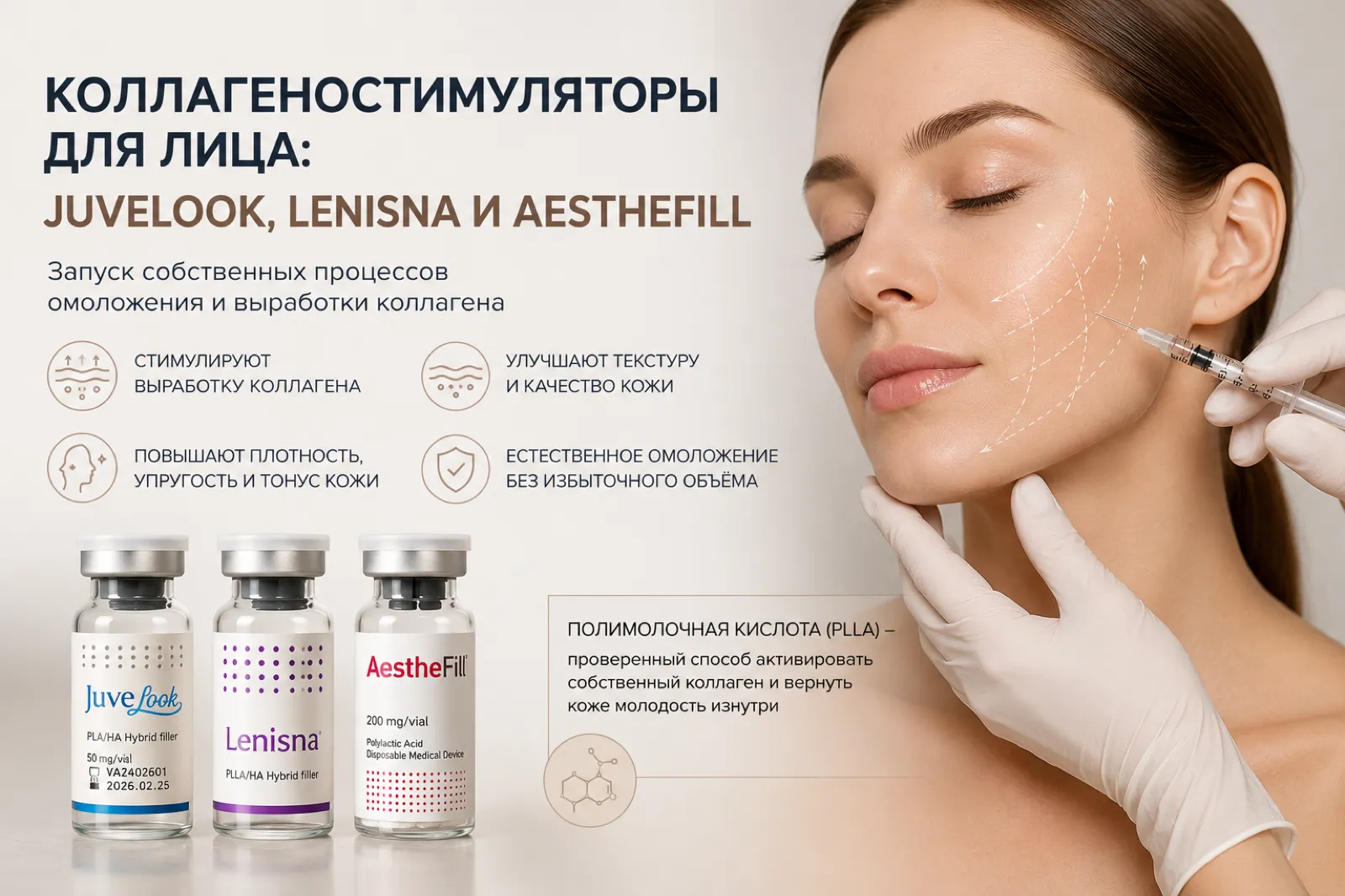
In our practice, for injectable rejuvenation programmes we use the modern products Juvelook, Lenisna and AestheFill.
Juvelook
Juvelook combines PDLLA particles with hyaluronic acid. This composition brings together a biostimulating effect and an effect on skin quality.
The product can be considered in programmes aimed at improving skin texture, fine lines and certain delicate areas. The specific areas of use and the injection technique are determined by the doctor after an in-person assessment of the tissues.
Lenisna
Lenisna is also a PDLLA-based product combined with hyaluronic acid, but it differs in the characteristics of its particles and is used for other aesthetic goals.
It is used in programmes that call for more pronounced work on tissue density, age-related changes and restoring the volume and structure of the face.
AestheFill
AestheFill is a collagen-stimulating product based on PDLLA. It works by gradually stimulating the formation of the body’s own collagen and restoring tissue quality.
It can be used for reduced skin density, age-related changes and loss of tissue support.
It is important to understand that Juvelook, Lenisna and AestheFill are not interchangeable products “for the same treatment”. Each has its own characteristics, indications, areas of use and injection protocols.
That is why a product is chosen not by popularity or name, but after assessing the anatomy of the face, the quality of the skin, how pronounced the signs of ageing are and the result you expect.
The main advantage: natural rejuvenation
In aesthetic medicine, the very idea of rejuvenation is gradually changing.
You don’t have to become “a different person”. A good result often means that the people around you notice your face looks fresher and your skin firmer and younger, but can’t tell which treatment you had.
That is exactly why collagen stimulation has become so widespread. It lets us work not on a single wrinkle but on the quality of the tissues as a whole.
The result develops gradually, because the body needs time to synthesise new collagen. How pronounced the effect is and how long it lasts are individual, and depend on age, skin condition, lifestyle, the product chosen and the treatment protocol.
Who collagen stimulation is for
The treatment can be considered for early and more pronounced signs of ageing, reduced skin density, sagging and changes in the contours of the face.
But prescribing collagen stimulators “by age” is wrong.
In two clients of the same age, the condition of the tissues can differ considerably. For one, polylactic acid really will be indicated; for the other, it is better to start with a completely different treatment or a combination of methods.
That is why an in-person consultation with an aesthetic doctor is needed before the treatment.
The specialist assesses the condition and thickness of the skin, the volume and distribution of subcutaneous fat, anatomical features, any contraindications and previous aesthetic treatments.
Are there contraindications and side effects?
Yes. Although polylactic acid is a biocompatible and biodegradable material, this is a medical injectable procedure.
After the injection, temporary swelling, redness, tenderness, small bruises and lumps are possible. Rarer complications include persistent papules or nodules, inflammatory reactions and other adverse events.
The risk of complications depends largely on proper client selection, preparation of the product, injection technique and depth, adherence to the protocol and following the aftercare advice.
That is exactly why collagen stimulation should be performed by a qualified medical professional trained to work with the specific product.
Not “adding volume”, but improving tissue quality
Collagen stimulation is a good reflection of the modern approach to aesthetic medicine.
We are less and less inclined to simply fill every wrinkle, and more and more focused on the cause of ageing: the loss of structural support and the change in tissue quality.
Polylactic acid makes it possible to use the body’s own regenerative potential by stimulating the gradual formation of collagen.
Juvelook, Lenisna and AestheFill give the doctor the option to tailor a programme to a specific skin and a specific aesthetic goal.
And the main goal of well-done collagen stimulation is not to change the face beyond recognition, but to help the skin look denser, firmer, fresher and naturally youthful.
This material is for information only. Whether a treatment is indicated, the choice of product, the number of treatments and the injection technique are determined individually by a medical specialist after a consultation.