
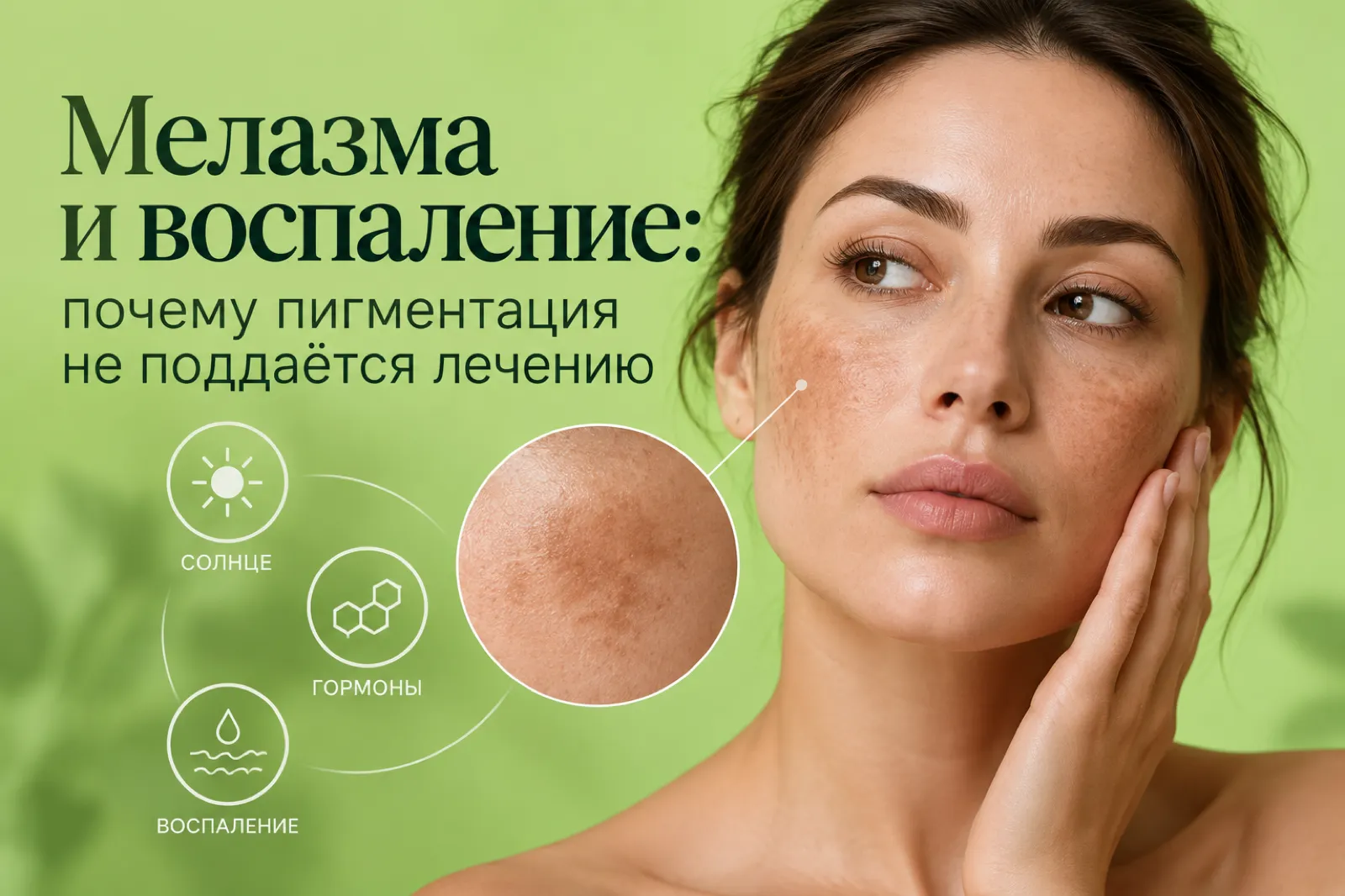
Melasma is one of the most difficult forms of hyperpigmentation. It appears as brown or grey-brown patches, most often on the cheeks, forehead, cheekbones, above the upper lip and on the chin.
Many people see melasma purely as an excess of melanin: if the skin produces too much pigment, it must be lightened or removed.
But the modern understanding of melasma is far more complex.
Melasma is not just a mark on the surface of the skin. It is a chronic condition involving melanocytes, keratinocytes, blood vessels, mast cells, fibroblasts, the basement membrane and inflammatory signals.
That is why it is quite understandable when pigmentation that has been treated with lightening products for months comes back or becomes even more noticeable.
Why melasma produces too much pigment
Melanin is produced by melanocytes, the cells responsible for skin pigmentation.
In melasma, the problem is not only the amount of melanin already accumulated. Melanocytes receive signals that keep them overactive.
Sunlight remains one of the main triggers. Ultraviolet light acts not only directly on pigmentation but also on other structures of the skin, stimulating the production of mediators that can intensify melanogenesis.
Hormonal factors, genetic predisposition, changes in blood vessels, chronic exposure to light and inflammatory processes may also play a part in the development of melasma.
That is why trying to act on melanin alone does not always remove the mechanism that makes the skin keep producing it.
How inflammation is linked to melasma
Inflammation doesn’t necessarily mean redness, swelling or a burning sensation.
The skin can harbour subclinical inflammation, meaning inflammation that is barely noticeable from the outside.
Studies of melasma tissue show the involvement of mast cells and inflammatory mediators. Changes in the upper layers of the dermis, in blood vessels and in the basement membrane have also been described.
Under the influence of ultraviolet light and other irritants, skin cells can release substances that stimulate melanocytes.
This creates a kind of chain:
irritation and exposure to light → inflammatory signals → melanocyte activation → increased melanin production → more pronounced pigmentation.
If this process continues, simply lightening the patch may not be enough.
Why aggressive treatment sometimes makes melasma darker
This is one of the most important points.
When someone wants to get rid of pigmentation faster, the temptation is to treat it as intensively as possible: a strong peel, several active products at once, or an aggressive device-based treatment.
But excessive damage to the skin can itself trigger an inflammatory reaction.
And inflammation can stimulate the formation of new pigment.
This creates a paradoxical situation:
the harder you try to remove pigment, the more strongly the skin responds by producing it.
This is especially important to bear in mind for people prone to post-inflammatory hyperpigmentation.
That is why treatments for melasma require careful choice of settings and monitoring of how the skin reacts. Laser and light-based methods can be used in certain cases, but they are not considered a universal first step for every client with melasma.
The blood vessel component of melasma
Another reason melasma is so persistent is that the problem may involve more than the pigment cells.
In areas of melasma, researchers find increased vascularisation – more blood vessels, and more visible ones – along with changes in the factors that regulate the formation of the vascular network.
This matters because cells of the blood vessels and surrounding tissues can exchange signals with melanocytes.
So, in a single area of skin, there can be all of the following at once:
- increased melanocyte activity;
- chronic inflammatory signals;
- changes in blood vessels;
- the effects of photodamage;
- changes in the basement membrane and dermis.
That is why two melasma patches that look similar in different people may call for completely different approaches.
A damaged skin barrier matters too
In the treatment of pigmentation, too many active ingredients are sometimes used at the same time: acids, retinoids, lightening agents, peels and home remedies.
If the skin is constantly irritated and becomes dry, tight, flaky or stinging, its barrier function is impaired.
In that situation, it isn’t always right to keep increasing the intensity of treatment.
First, a specialist needs to assess the condition of the skin and work out whether the irritation is sustaining an inflammatory process.
Sometimes the route to less pigmentation starts not with a stronger lightening product, but with restoring the skin’s normal condition and reducing its reactivity.
Why melasma comes back after treatment
Melasma typically follows a recurrent course.
Even if the amount of visible pigment has been reduced significantly, the skin’s tendency to produce it may remain. Current research sees melasma as a far more complex condition than a local build-up of melanin.
That is why a result needs not only to be achieved but also to be maintained.
If you give up sun protection and maintenance care altogether after a course of treatments, the likelihood of pigmentation returning increases.
Light is one of the main triggers
In melasma, sun protection is not an optional extra step of skincare but part of the therapy.
Regular protection of the skin from sunlight is especially important. And it is not only ultraviolet light that can affect pigmentation: visible light can too.
That is why a specialist may recommend daily use of broad-spectrum sun protection and, in some cases, products containing iron oxide pigments, which give additional protection against part of the visible light.
Without control over exposure to light, even a well-chosen therapy can give an unstable result.
Why a single peel or laser doesn’t solve the problem for good
A treatment can reduce the amount of pigment, but it doesn’t necessarily eliminate all the mechanisms that sustain melasma.
That is why the modern approach is more often built not around a single “strongest” treatment but around a combination of methods.
Depending on the condition of the skin, a programme may include:
inflammation control → restoring the skin barrier → daily sun protection → products that regulate melanogenesis → professional treatments → maintenance therapy.
Peels, microneedling, device-based treatments and other procedures can be part of such a programme, but they must be chosen individually.
Skin that has already reacted with increased pigmentation after aggressive treatments needs an especially cautious approach.
What to do if pigmentation “won’t clear”
If melasma comes back after every course or barely responds to home products, it doesn’t necessarily mean you should use a stronger treatment.
At the consultation, it is important to assess:
the nature and depth of the pigmentation, the condition of the skin barrier, any signs of irritation and inflammation, the blood vessel component, home care, use of SPF, previous treatments and how the skin reacted to them.
Only after that does it make sense to draw up a correction programme.
Sometimes you first need to calm the skin and restore the barrier, and only then gradually work on the pigmentation.
The main points
Persistent melasma is not simply “pigment that just can’t be removed”.
Today melasma is regarded as a multifactorial, chronic skin condition in which pigmentation is linked to a whole system of processes: exposure to light, inflammatory signals, changes in blood vessels, and the condition of the dermis and basement membrane.
That is why the specialist’s task is not to destroy the pigment as quickly as possible, but to understand why the skin keeps producing it.
It is a comprehensive and gentle strategy that reduces how pronounced melasma is and, importantly, lowers the likelihood of its quick return.
Consultation with a High Care specialist
If pigmentation returns after peels, skincare products or device-based treatments, it is worth working out why it persists before repeating another course.
At High Care, a specialist assesses the condition of your skin, the characteristics of the pigmentation and your previous treatment experience, then puts together an individual correction and home care programme.
This material is for information only and is not a substitute for a doctor’s consultation.