
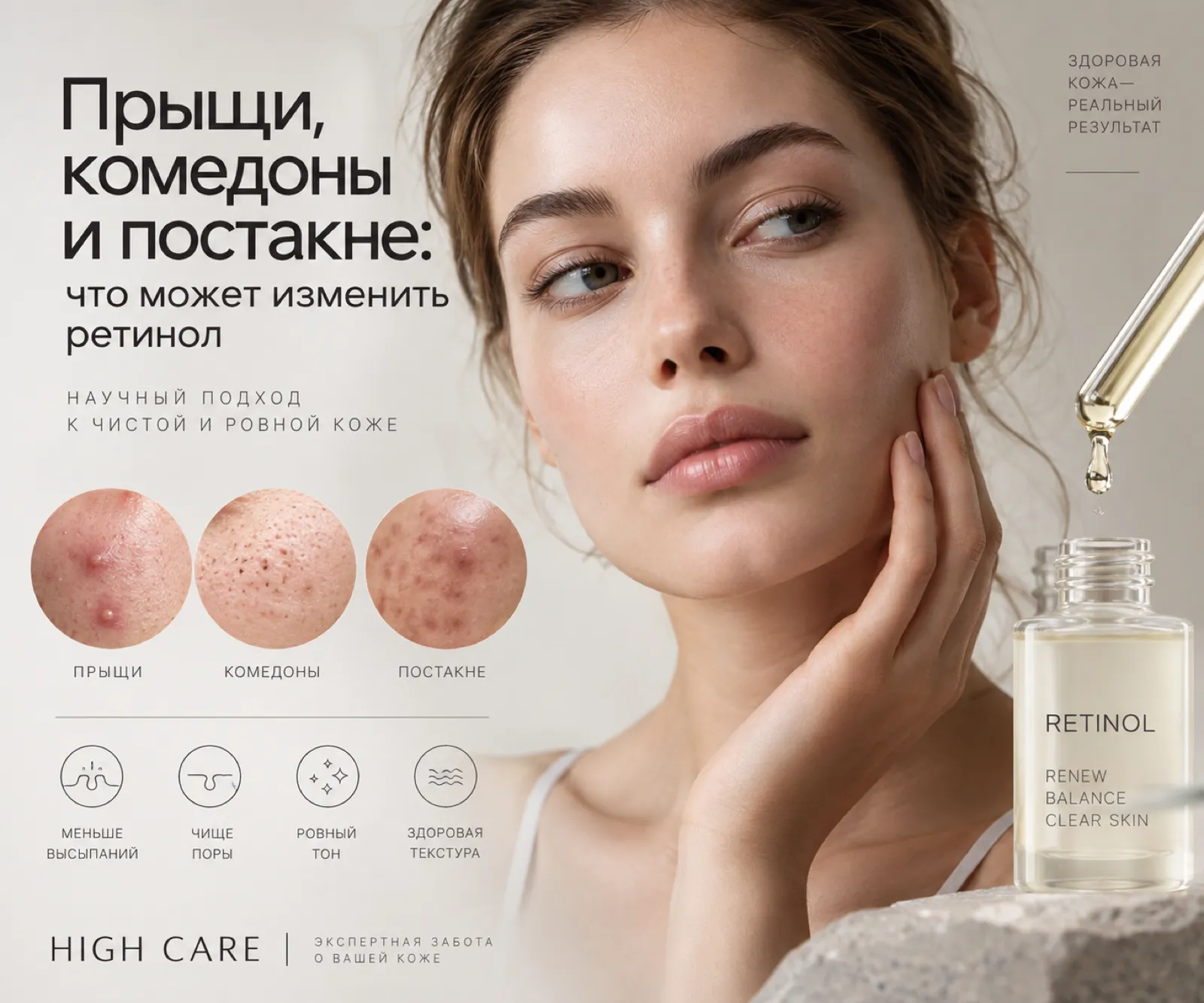
Acne is rarely limited to a single inflamed spot. Many people have closed and open comedones, recurring inflammation, uneven skin texture and marks that linger long after the breakouts have gone.
One of the best-studied approaches for this kind of skin is the use of retinoids, derivatives of vitamin A. They have been used in dermatology for decades and feature in current guidelines for acne treatment. However, there is a real difference between cosmetic retinol and prescription retinoids, and the result depends largely on the right form, strength and regimen.
What happens to the skin in acne
Normally, the cells of the epidermis renew constantly, and sebum flows freely out through the opening of the hair follicle.
In acne, this process is disrupted. Excess sebum production combines with a change in how skin cells shed. As a result, a plug gradually forms in the follicle.
At first it may be almost invisible – this is a microcomedone. Then the familiar closed whiteheads or open comedones, which look like blackheads, appear.
If inflammation sets in, papules and pustules develop – the inflamed spots commonly known as pimples.
This is why acne treatment should target more than the inflammation that has already appeared. It is just as important to act on the mechanism that forms new comedones.
What retinoids do
Retinoids act on the processes of skin cell renewal and differentiation. In acne, one of their most important effects is normalising how cells shed around the follicle.
Put simply, cells are less likely to form a dense plug inside the pore.
So, with properly chosen therapy, retinoids can:
- reduce the number of closed and open comedones;
- prevent new comedones from forming;
- reduce inflamed spots;
- gradually even out skin texture;
- help with some types of post-inflammatory pigmentation;
- serve as maintenance therapy once acne is under control.
It is this ability to act on how a comedone forms that makes retinoids especially important in comedonal acne.
Retinol and retinoids are not the same thing
These terms are often confused.
Retinoids are a large group of compounds related to vitamin A. They include retinol, retinal, adapalene, tretinoin, tazarotene, trifarotene and others.
Retinol is widely used in cosmetic products. It can improve skin texture, reduce the look of pigmentation and help with mild acne.
But in clinical acne treatment, dermatologists may use prescription topical retinoids, such as adapalene or tretinoin. Their action and the evidence for their use in acne differ from those of ordinary cosmetic retinol.
So a “retinol” product from a beauty shop and a retinoid prescribed by a doctor are not interchangeable.
What happens with comedones
One common mistake is trying to keep clearing comedones out mechanically.
Cleansing can indeed remove the contents of an existing comedone. But if the mechanism that forms it persists, the problem can return after a while.
Retinoids work differently.
Their job is less about physically removing the contents of a pore and more about changing how it becomes blocked. Gradually, the number of microcomedones – the precursors of visible blackheads and whiteheads – goes down.
That is why the effect does not develop in a few days.
In acne therapy, results are usually judged over weeks and months. For example, NICE guidance treats a 12-week course as the standard first-line period for acne treatment.
And what about spots?
Retinoids can reduce the formation of new inflamed spots, but in inflammatory acne one medicine is often not enough.
Depending on the type and severity of the condition, a doctor may combine a retinoid with benzoyl peroxide, azelaic acid or other medicines. More severe acne may need systemic treatment.
The modern approach, therefore, is not to look for one “perfect anti-spot product” but to choose a combination of medicines that act on different mechanisms of the condition.
Can retinol clear post-acne marks?
It is important to understand that the word “post-acne” can cover very different changes.
If a flat red or brown mark is left after inflammation, it is not necessarily a scar. Post-inflammatory hyperpigmentation, for example, is a change in skin colour and may become less noticeable over time. The American Academy of Dermatology specifically stresses that such flat marks are not true scars.
Retinoids can speed up epidermal renewal and help some post-acne dark spots fade gradually.
Atrophic scars are a completely different matter: depressions, “pits” and a lasting change in the skin’s surface.
Here, expecting retinol alone to fully restore the skin’s structure would be wrong. Correcting established scars may call for other dermatological and cosmetic methods, chosen individually after an examination.
Why skin sometimes looks worse at first
Starting retinoids takes patience.
Your skin may react with:
- dryness;
- flaking;
- a feeling of tightness;
- redness;
- increased sensitivity.
This does not mean that the more your skin flakes, the better the product is working.
Marked irritation is not the goal of therapy.
To lower the chance of an unwanted reaction, retinoids are often introduced gradually. For example, NICE recommends, where needed, starting with application every other day or using short contact time on the skin, then increasing the frequency as tolerance builds.
The exact regimen depends on the product and the condition of your skin.
Moisturising matters in acne
Oily, acne-prone skin needs moisturising too.
While using retinoids this matters even more. A well-chosen non-comedogenic moisturiser helps maintain the skin barrier and makes therapy easier to tolerate.
For sensitive skin, a doctor may recommend applying moisturiser before the retinoid, or changing how often it is used. This approach is used specifically to reduce irritation.
At the same time, harsh scrubs, frequent acid peels and a large number of active ingredients at once can, on the contrary, make irritation worse.
SPF is an essential part of your routine
If you are treating acne and post-acne marks, protection from ultraviolet radiation becomes especially important.
Inflamed, irritated skin is more prone to lasting pigment changes, and some acne medicines make skin more sensitive to the sun.
That is why a broad-spectrum sunscreen of SPF 30 or higher, ideally labelled non-comedogenic, is usually part of the daytime routine.
When retinol isn’t enough
Skincare is no substitute for diagnosis.
See a doctor especially if you develop painful deep inflammation, nodules or numerous breakouts, if scars begin to form, or if acne persists despite regular home care.
The longer marked inflammation lasts, the more likely it is to leave lasting marks.
In such cases the specialist’s task is to determine the type and severity of the acne, assess the condition of the skin barrier and choose therapy that targets the causes of the condition.
The main points
Retinol and other retinoids can indeed change the condition of problem skin significantly, but their effect goes well beyond simple “exfoliation”.
In acne, their influence on how comedones form matters most. With properly chosen therapy, pore blockage gradually decreases, there are fewer new breakouts, skin texture evens out and some post-acne marks become less noticeable.
But retinoids need to be used correctly.
There is no universal strength or regimen that suits everyone. With marked acne, sensitive skin, persistent post-acne marks or scars, it is best to choose your treatment and care programme together with a doctor.
One more thing to remember: topical retinoids are contraindicated during pregnancy and when planning a pregnancy.
At High Care, we assess the skin as a whole: the aim is not just to temporarily reduce the number of breakouts, but to understand what keeps them coming back, tell pigment changes from true scars and put together a consistent care and treatment programme.
This material is for information only. Whether a treatment is indicated, the choice of product, the number of treatments and the injection technique are determined individually by a medical specialist after a consultation.